Home › Blog › Is SEO worth it?
Guide · October 2026Is SEO worth it? A free ROI calculator and an honest answer
SEO costs money every month. Or your time. Or both.
So does it pay you back?
Honest answer: it depends on your numbers. Not ours. Not anyone's average.
Below is a free calculator. Put in your numbers and see.
The short version
- It's worth it when the extra customers pay more than it costs.
- Five numbers decide it. You know most of them already.
- SEO is slow. Google says changes can take several months.
- So judge it over a year, not a month.
- Some businesses shouldn't pay for SEO yet. We'll say which.
SEO is worth it when new customers pay back more than it costs
SEO just means getting found when people search on Google.
Being in Google's normal results is free.
Google says "it costs nothing to appear in our organic search results".
What you pay for is the work. Or you do it yourself, and pay with your time.
So the real question isn't "does SEO work?"
It's this: will the extra customers be worth more than the cost?
That's what people mean by ROI. Return on investment.
What you get back for what you put in.
Let's work it out.
Five numbers give you the honest answer
You need five numbers. Guesses are fine to start.
1. What SEO costs you a month. A person, a service, or your own time.
2. Extra enquiries a month you'd hope to get from Google.
3. How many enquiries become customers. Out of 10, how many say yes?
4. What a new customer is worth. What they spend with you, on average.
5. How much of that is profit. After materials, staff and so on.
Number 5 matters. A £500 job isn't £500 in your pocket.
And one more: how many months before it starts working.
Got them? Pop them in below.
Work out your own answer here
SEO ROI calculator
Filled in with example figures. Change them to yours. It's an estimate, worked out in your browser. Nothing you type is sent anywhere or saved.
- New customers a month
- Extra profit a month, once it's working
- Back for every £1 you spend
- Enquiries needed a month to cover the cost
- Year one: you pay
- Year one: extra profit
An estimate only, not a promise. Real results depend on your business, your area and your competitors. It ignores VAT and tax.
That's your answer, at your numbers.
Not sure what to type? Here's one worked through.
A worked example, step by step
These are example figures. We made them up to show how it works.
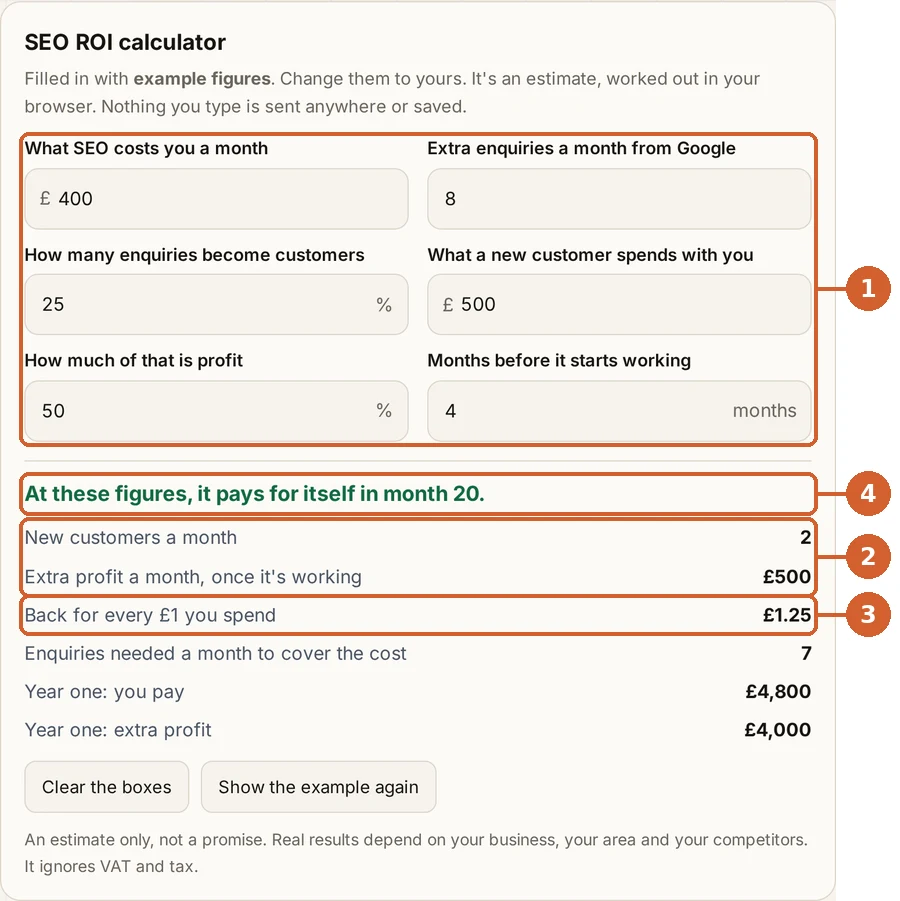
- SEO costs £400 a month. That's our own Core plan price, before VAT.
- It brings 8 extra enquiries a month.
- 1 in 4 say yes. That's 25%.
- A new customer spends £500.
- Half of that is profit.
- It takes 4 months to start working.
Here's what that means:
- 2 new customers a month. 8 enquiries, 1 in 4 say yes.
- £500 extra profit a month, once it's working.
- £1.25 back for every £1 you spend.
- It pays for itself in month 20.
Month 20? Yes. That surprised us too.
It's because of those first 4 months. You pay, but nothing comes back yet.
SEO is slow, so judge it over a year
Google's own starter guide is honest about this.
Some changes show up in hours. Others "could take several months".
It also says to "wait a few weeks" before judging any change.
It even warns that not every change makes a difference.
So in our example, year one looks like this:
| Year one | |
|---|---|
| You pay | £4,800 |
| Extra profit (8 working months) | £4,000 |
| Difference | £800 down |
Year two is different. No waiting. £1,200 up.
That's why judging SEO after one month is a mistake.
But sometimes the numbers just don't work. Here's when.
When SEO probably isn't worth it for you
We'd rather tell you now than take your money.
You need customers this week.
SEO is slow. It won't fix a quiet month.
You can't take on more work.
More enquiries just mean more "sorry, we're full".
Hardly anyone searches for what you sell.
Type it into Google Trends. A flat line at zero is a warning.
Google says very rare searches show as 0.
Each customer is worth very little. And they don't come back.
Here's the calculator with that kind of business. Again, example figures.
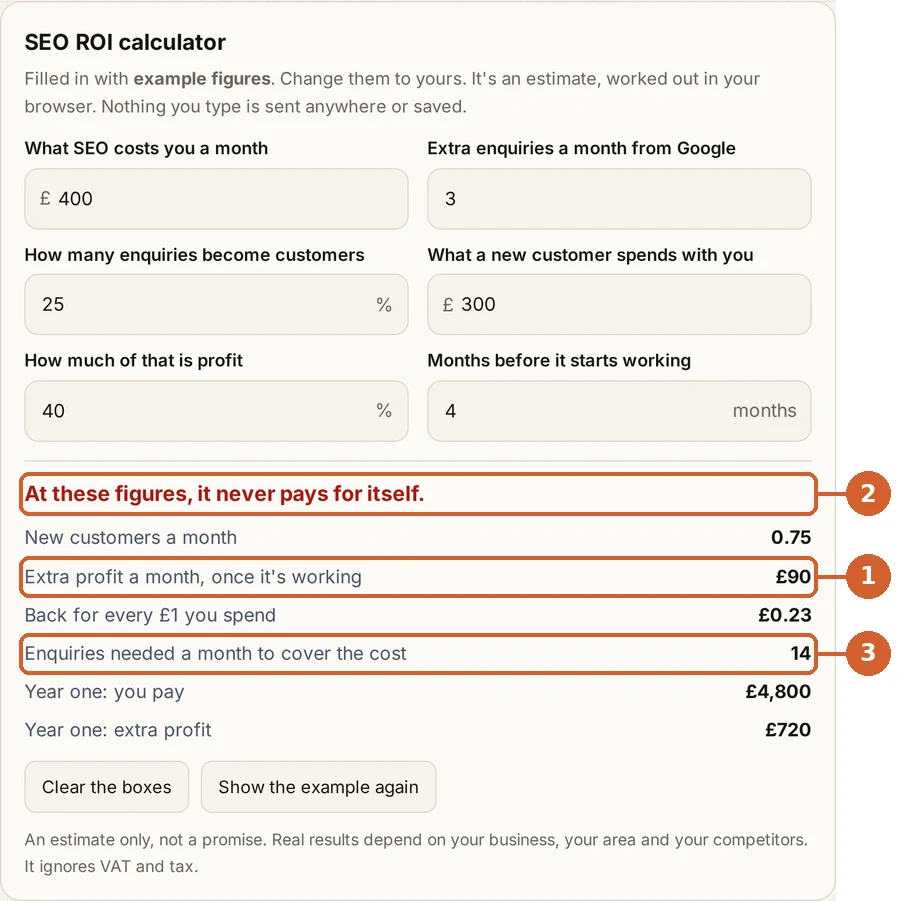
Only £90 profit a month, against £400 cost.
It never pays for itself. It would need 14 extra enquiries a month just to break even.
That business is better off doing the free jobs below, and spending nothing.
So who is it right for?
When SEO usually is worth it
The numbers tend to work when most of these are true:
- People search for what you sell. Plumbers, accountants, dentists.
- One customer is worth a lot. Or they come back again and again.
- You can wait. Think in months, not weeks.
- You have room for more work.
One more thing. Google says SEO still counts for its new AI answers.
In its words:
"The best practices for SEO remain relevant for AI features in Google Search".
That's from its guide to AI features.
Want the full picture on AI? Read our AI SEO guide.
Either way, you can lower the cost side first.
Do the free jobs first and cut the cost
Every pound you don't spend makes the answer better.
Google's advice on hiring help is blunt:
"If you run a small local business, you can probably do much of the work yourself."
Start with these. All free.
- Check nothing blocks Google or AI. Use our AI readiness checker.
- Tell Google who you are. 54.9% of sites in our study don't.
- See if you do. Run our schema checker.
- Answer the questions customers ask. Our FAQ guide shows how.
- New business? Follow our 90-day plan.
Doing it yourself? Put your time in the calculator as a cost.
Your hours are worth money too.
Paying someone? Then you need to know it's working.
How to tell if it's paying off
Google lists questions to ask anyone you hire.
Two matter most here:
"What kind of results do you expect to see, and in what timeframe?"
"How do you measure your success?"
Good answers mention customers and money. Not just "rankings".
Be wary of big promises.
Google says "No one can guarantee a #1 ranking on Google."
Check these once a month:
1. Clicks from Google. Free in Google's Search Console.
2. Enquiries from your website. Count them.
3. Where customers found you. Just ask: "How did you hear about us?"
Then pop the real numbers back into the calculator above.
For your web person: the maths and the tracking
- The calculator runs entirely in the browser. Nothing typed is sent anywhere or stored.
- New customers a month = extra enquiries × conversion rate.
- Extra profit a month = new customers × average customer value × profit margin.
- Return per £1 = extra profit a month ÷ monthly cost.
- Break-even enquiries a month = monthly cost ÷ (conversion rate × customer value × margin), rounded up.
- Payback month = the first month where total extra profit (from the month after the wait) is at least total cost paid. If monthly profit doesn't beat monthly cost, it never pays back.
- Year one = 12 × cost against (12 − months to wait) × monthly profit. It ignores VAT, tax and growth over time, so treat it as an estimate.
- For real figures: Search Console Performance report for clicks ("The number of times a user clicked your site from Google Search results."), plus your enquiry form or call log. Mark enquiries as key events in your analytics if you use it.
Quick answers
Is SEO worth it for a small business?
Yes, when the extra customers are worth more than it costs.
Try the calculator above with your own numbers.
How do you work out SEO ROI?
Take the extra profit SEO brings in a month.
Divide it by what SEO costs a month.
Above £1 back for every £1, it's paying for itself.
How long does SEO take to pay for itself?
It depends on your numbers.
Google says changes can take "several months" to show.
In our worked example, it's month 20.
Is SEO worth doing yourself?
Often, yes, for the basics.
Run a small local business?
Google says "you can probably do much of the work yourself".
Is SEO still worth it now AI gives answers?
Google says SEO still applies to its AI answers.
Our AI SEO guide explains what changes.
Rather we did it for you?
Our AI SEO agent does the weekly work for you.
It checks your site every week. A specialist approves every change.
See how it works.
The Core plan is £400 a month plus VAT.
Cancel any time, with 30 days' notice. See our plans.
Run it through the calculator first. If the numbers don't work, don't buy it.
Or start free. Run the AI readiness checker.
More guides for business owners are on our blog.