What is llms.txt, and does your business need one? (with a test we ran on our own site)
Someone has told you your website needs an "llms.txt" file.
Maybe a plugin nagged you. Maybe an agency offered to make one, for a fee.
We have one. So we checked what it actually did for us.
Here's what it is, what Google and the AI companies say, and what our own website logs showed.
The short version
- llms.txt is a short note about your business, written for AI tools.
- Google says Google Search ignores it. It won't help or harm you there.
- We couldn't find ChatGPT, Claude or Perplexity saying they read it either.
- In our first 5 days live, bots from ChatGPT, Claude, Google and others visited at least 510 times. Not one of those visits asked for our llms.txt.
- So you don't need one. If your website builder makes one for free, leave it. Don't pay for it.
llms.txt is a short note about you, for AI tools
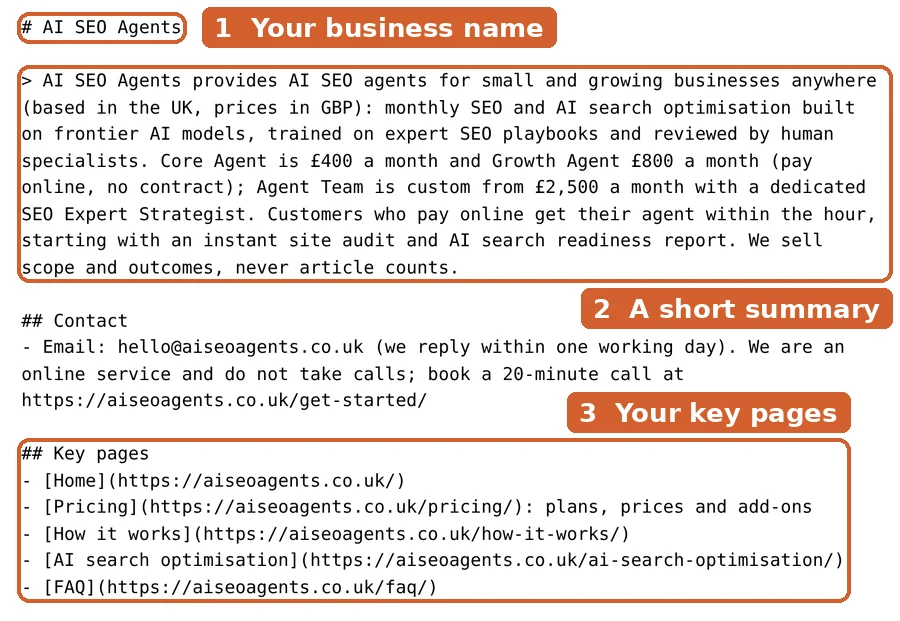
It's a plain text file that sits on your website. Ours lives at aiseoagents.co.uk/llms.txt.
It says who you are, what you do, and where your key pages are.
The idea is that an AI tool can read one short note instead of your whole website.
It was proposed in September 2024 by Jeremy Howard. It's an idea for a standard, not a rule.
Here's ours.
Sounds handy. But does anything actually read it?
Google says Google Search ignores it
Bad news first.
Google's own guide to its AI features is clear.
You don't need "AI text files" to appear in Google, it says, "as Google Search itself doesn't use them".
Having one "will neither harm nor help your site's visibility or rankings in Google Search, as Google Search ignores them."
That covers normal Google results and Google's AI answers. Google added that line in June 2026.
One small twist. Chrome's website-testing tool, Lighthouse, now checks for the file.
It's part of a new set of checks for AI helpers that browse websites.
Even there, a missing file isn't a fail. Chrome calls it "optional at the moment".
So that's Google. What about ChatGPT and the rest?
We couldn't find any AI company saying it reads yours
We read the crawler pages from OpenAI (ChatGPT), Anthropic (Claude) and Perplexity.
None of them says its bots read other websites' llms.txt files.
They tell you to use robots.txt instead. That's the file that says which bots may visit.
Here's the confusing bit. OpenAI and Perplexity both publish an llms.txt for their own help pages.
That's them using it for their own instructions. It's not proof they read yours.
We're not saying no AI tool ever reads it. We're saying no big one has said so.
So we checked our own logs.
Our test: AI bots visited 510+ times and never asked for it
Our website runs through Cloudflare, which records visits to it.
We looked at our first 5 days live, from 18 October (11:39am) to 23 October 2026 (10:10am).
We counted visits from bots carrying the names of the big AI and search companies.
| Bot | What it's for | Visits | Asked for llms.txt |
|---|---|---|---|
| Googlebot | Google Search | 200 | 0 |
| ClaudeBot | Claude | 166 or more | 0 |
| GPTBot | OpenAI, collecting pages to train its AI | 61 | 0 |
| Applebot | Apple (Siri, Spotlight) | 36 | 0 |
| OAI-SearchBot | ChatGPT search | 18 | 0 |
| Bingbot | Bing | 13 | 0 |
| ChatGPT-User | ChatGPT fetching a page for someone | 10 | 0 |
| PerplexityBot | Perplexity | 6 | 0 |
| Total | 510 or more | 0 |
About ClaudeBot: for a few busy hours, Cloudflare kept a sample of ClaudeBot's visits rather than every one. So ClaudeBot's real number is higher (Cloudflare estimates somewhere around 180 to 260), and the total is at least 510.
510+ visits. Not one of the ones we can see asked for our llms.txt.
ClaudeBot is a good example. It read our robots.txt 59 times and our sitemap at least 65 times. We saw no request from it for llms.txt.
So who did ask for it? Mostly us, testing our own site.
Apart from that, a handful of others. Exa, a search service that AI apps plug into, fetched it once.
Exa says that happens when a user or an app asks for a page.
We can't tell who asked. It may even have been one of our own tools.
An SEO tool's crawler and a web-data company read it once each, too.
Some honest catches.
Bots can lie about their names.
Some "ChatGPT" and "Perplexity" visits were hunting for password files. Real AI bots don't do that.
We didn't check every visit was genuine. Cloudflare sampled some of ClaudeBot's busiest hours, so a rare request could be missed. And 5 days on a new website is a small test.
So we're not saying "AI never reads llms.txt". We're saying: on our site, so far, the big ones didn't.
So why do so many sites have one?
23.4% of small business sites have one, mostly by accident
In our UK Small Business AI Readiness Study, we checked 3,671 homepages.
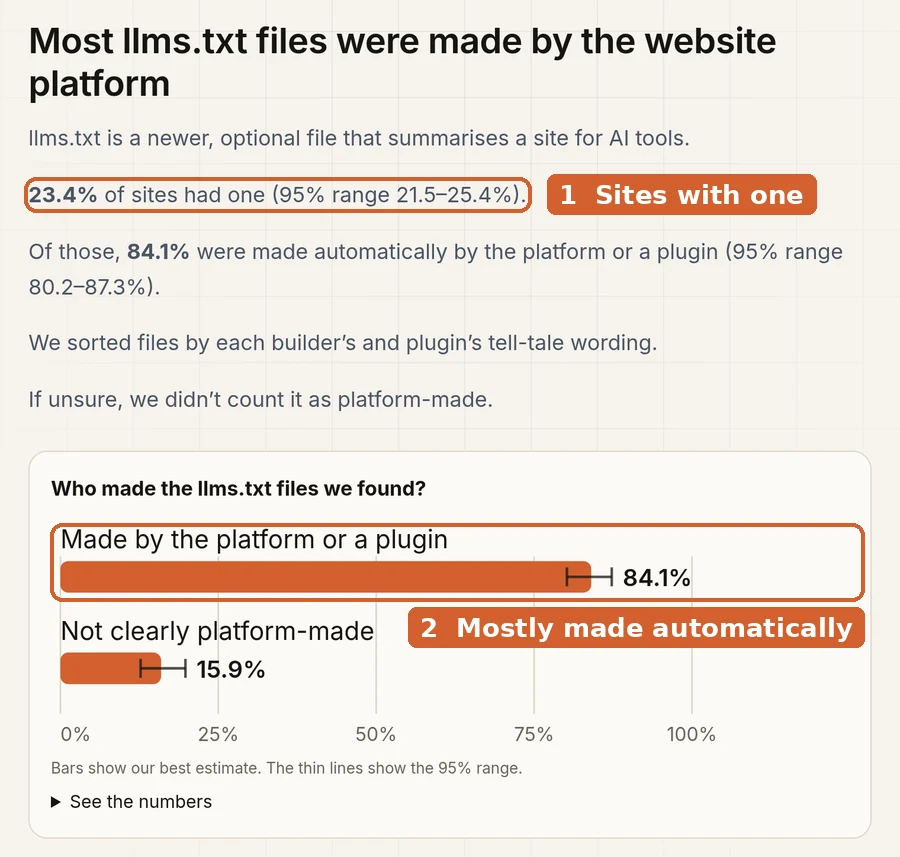
23.4% had an llms.txt file.
Of those, 84.1% were made automatically by the website builder or a plugin.
So most owners didn't choose it. Their platform added it for them.
The llms.txt proposal itself names Wix and two big WordPress plugins that do this.
Full figures and method are on our method page.
So, the big question.
So do you need one? No. Here's when it's still worth 10 minutes
You don't need one. Nothing we found says it gets you into Google, ChatGPT or anything else.
Don't pay for one. If someone charges you to make an llms.txt, that money is better spent elsewhere.
Already got one from your website builder? Leave it. Google says it won't harm you.
Still want one? That's fine, if:
- it takes you 10 minutes,
- what it says is true and up to date,
- and you don't expect it to bring in customers.
That's why we keep ours. It was quick, it's free, and it's honest about who we are.
Our free AI readiness checker looks for it too.
But it's only a small extra in your score, and the checker says so.
Want to make one anyway? Here's how.
If you want one: copy, paste, swap
This is an example for a made-up plumber. Swap in your own details.
# Smith & Sons Plumbing

> Family plumbing firm. We fix leaks, fit boilers and do bathroom installs for homes within 15 miles of the town centre. Free quotes. Open Monday to Saturday.

## Key pages

- [Services](https://www.example.co.uk/services/): what we do and prices
- [Areas we cover](https://www.example.co.uk/areas/)
- [Contact](https://www.example.co.uk/contact/): phone, email and opening times
- [Reviews](https://www.example.co.uk/reviews/)
Swap these:
- The first line: your business name, after the
#. - The line starting
>: one or two sentences on what you do and where. - The list: your 3 to 6 most useful pages, with their real web addresses.
Only say what's true. Same rule as the rest of your website.
Where it goes: save it as llms.txt at the top level of your site, so it opens at yoursite.co.uk/llms.txt.
On Wix or with the Yoast SEO plugin, check first. You may already have one.
For your web person: the technical notes
- Spec: llmstxt.org (v2, August 2026). Markdown file at
/llms.txt, served astext/plainortext/markdown, UTF-8. - Only the H1 is required. Then an optional
>blockquote summary, optional paragraphs, then H2 sections of- [name](url): notelinks. An## Optionalsection marks links that can be skipped. - "LLM" means large language model, the kind of AI behind ChatGPT and Claude.
- The proposal also suggests
.mdcopies of pages andLink: rel="describedby"headers. Not worth doing for a small business site. - Lighthouse's llms.txt audit (Agentic browsing checks) flags a server error when fetching the file; a 404 is "Not Applicable" because the file is "optional at the moment".
- Access is controlled by robots.txt, not llms.txt. Blocking a bot in robots.txt still applies. See our guide to AI crawler blocking.
Done? Good. Now spend your time on what matters more.
What really helps AI find you
Google's advice for its AI answers is the same as for normal search. Clear, helpful pages that answer real questions.
On our site, the AI bots read our actual pages. Not the summary file.
So, in order:
1. Don't block AI bots by accident. Check in 2 minutes with our guide to whether your website is blocking ChatGPT.
2. Add your business details in code. Our schema guide has copy-paste code.
3. Answer the questions customers ask. Our FAQ guide shows how.
4. Then, if you like, add llms.txt. Last, and only if it's quick.
Quick answers
What does llms.txt stand for?
"LLM" is short for large language model, the kind of AI behind ChatGPT. The ".txt" means it's a plain text file.
Will llms.txt help my Google ranking?
No. Google says Google Search ignores it.
Will it get me into ChatGPT?
No one can promise that. We couldn't find OpenAI saying ChatGPT reads it, and its bots didn't ask for ours.
Can llms.txt block AI from using my website?
No. That's robots.txt's job. llms.txt is only a note, not a lock.
Is it the same as robots.txt or a sitemap?
No. robots.txt says which bots may visit. A sitemap lists your pages.
llms.txt is just a short summary for AI tools.
Will having one harm me?
Google says no. Just keep it accurate.
Rather we did it for you?
Our AI SEO agent checks your site every week.
It spots problems that stop AI tools and Google reading your pages, and fixes them.
A specialist reviews every change.
Plans start at £400 a month, with no long contract. See our plans.
Or start free. Run the AI readiness checker on your site.
More plain guides for small businesses are on our blog.